


 Cart
Cart
 sales@molnova.com



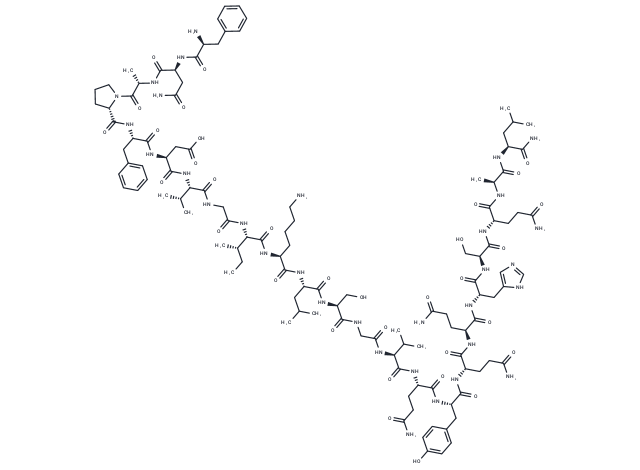
Obestatin (human)
CAS No. 1081110-72-6
Obestatin (human)( —— )
Catalog No. M35043 CAS No. 1081110-72-6
Obestatin (human) is an endogenous ligand for G-protein eurythmic entity 39 formed by shearing of preproghrelin, which inhibits feeding in a dose-dependent manner, and can be used in the study of obesity.
Purity : >98% (HPLC)
 COA
Datasheet
HNMR
HPLC
MSDS
Handing Instructions
COA
Datasheet
HNMR
HPLC
MSDS
Handing Instructions
| Size | Price / USD | Stock | Quantity |
| 2MG | 196 | Get Quote |


|
| 5MG | 376 | Get Quote |
|
| 10MG | 566 | Get Quote |
|
| 25MG | 858 | Get Quote |
|
| 50MG | 1150 | Get Quote |
|
| 100MG | 1521 | Get Quote |
|
| 500MG | Get Quote | Get Quote |
|
| 1G | Get Quote | Get Quote |
|
Biological Information
-
Product NameObestatin (human)
-
NoteResearch use only, not for human use.
-
Brief DescriptionObestatin (human) is an endogenous ligand for G-protein eurythmic entity 39 formed by shearing of preproghrelin, which inhibits feeding in a dose-dependent manner, and can be used in the study of obesity.
-
DescriptionObestatin(human) is a 23-amino acid amidated peptide that regulates appetite and gastrointestinal motility via its interaction with GPR39. Obestatin(human) can be used for weight loss. Obestatin(human) cannot penetrate the cell membrane.
-
In VitroThe primary structure of Obestatin(human) indicates that it only presented one lysine at position 10, which suggests that it cannot penetrate the cell membrane.
-
In VivoIn adult male mice, intraperitoneal injection of Obestatin(human) suppresses food intake in a timeand dose-dependent manner.
-
Synonyms——
-
PathwayOthers
-
TargetOther Targets
-
RecptorOthers
-
Research Area——
-
Indication——
Chemical Information
-
CAS Number1081110-72-6
-
Formula Weight2546.83
-
Molecular FormulaC116H176N32O33
-
Purity>98% (HPLC)
-
SolubilityIn Vitro:?DMSO : 1.96 mg/mL (0.77 mM; ultrasonic and adjust pH to 5 with HCl )
-
SMILESC(N[C@@H](CC1=CC=CC=C1)C(N[C@H](C(N[C@H](C(NCC(N[C@H](C(N[C@H](C(N[C@H](C(N[C@H](C(NCC(N[C@H](C(N[C@H](C(N[C@@H](CC2=CC=C(O)C=C2)C(N[C@H](C(N[C@H](C(N[C@@H](CC3=CN=CN3)C(N[C@H](C(N[C@H](C(N[C@H](C(N[C@@H](CC(C)C)C(N)=O)=O)C)=O)CCC(N)=O)=O)CO)=O)=O)CCC(N)=O)=O)CCC(N)=O)=O)=O)CCC(N)=O)=O)C(C)C)=O)=O)CO)=O)CC(C)C)=O)CCCCN)=O)[C@H](CC)C)=O)=O)[C@@H](C)C)=O)CC(O)=O)=O)(=O)[C@H]4N(C([C@@H](NC([C@@H](NC([C@H](CC5=CC=CC=C5)N)=O)CC(N)=O)=O)C)=O)CCC4
-
Chemical Name——
Shipping & Storage Information
-
Storage(-20℃)
-
ShippingWith Ice Pack
-
Stability≥ 2 years
Reference
1. Guangcai Ren, et al. Effect of TAT-obestatin on proliferation, differentiation, apoptosis and lipolysis in 3T3-L1 preadipocytes. J Pept Sci. 2013 Nov;19(11):684-91.?
molnova catalog



related products
-
XMP
XMP is an intermediate in purine metabolism.
-
Bendazac
Bendazac is an anticataract drug. It may act by preventing protein denaturation.
-
p-Hydroxybenzaldehyd...
4-Hydroxybenzaldehyde shows an inhibitory effect on the GABA transaminase to contribute to an antiepileptic and anticonvulsive activity.
